 We finally started our front-end corporate presence as a result of our recent commitment to build aerospace simulators again after more than a decade!
Blog
-
Welcome Back
-
Aliens
About a month ago (after a hiatus lasting a bit more than a decade) Ian and I decided to make cockpit simulators again (one at each person’s house). Both with families and kids now all would benefit from not only flying them but also from the construction and maintenance. It would leverage the engine we built for Rise (visuals, physics, and database) over a period of 6 years which was all but abandoned last year as an MMORPG concept.
Mine will be based on the Utility Dropship (UD-4L Cheyenne) cockpit (inspired by the Apache helicopter) from the 1986 movie Aliens. I was able to find the original set blueprints and am currently designing the motion platform.
-
Artery Game
Map
Tunnel
wall is more complicated than I thought
Branch frequency is inversely proportional to the diameter
Branches aren’t complicated and are half the volume of the trunk
width (ID) 24000µm to 47000µm (aorta) to 8µm (capillary)
contain endothelial cells that are 1-2µm thick and 10-20µm in diameter (flat pavement like patterns to seal vessel)
Sounds
the whump-whump of the heart beating (or the heart valves snapping shut)
the whoosh of the plasma as it is forced through the blood vessels
Visuals
see the inside of the blood vessels (as the red blood cells do not leave the blood vessels and enter the organs – only the plasma and dissolved substances do this)
color change of the RBC as it goes through capillaries in lungs vs. other capillaries (organs, skin)
it seemed to become lighter as you passed through the blood vessels near the surface of the skin (like the ones in your wrist).
GamePlay
Round-trip is about one minute (on average) 20 seconds minimum and I guess 100 seconds
Talked about dilating time to the same extent that we are shrinking ourselves
HUD
A vial or set of vials to show stats?
http://www.fontspace.com/category/blood
Website
Blood on white looks really crisp
http://www.aurorahealthcare.org/healthgate/images/si2037.jpg
http://www.hivplusmag.com/plus_weekly_email/images_rf/blood_Africa.jpg
Shadows
Objects
(rbc, wbc*5, platelets)
The neutrophil are the more common leukocytes. They have a diameter of 12-15 µm. You can recognize them as their nucleus is divided into 2 – 5 lobes connected by a fine nuclear strand or filament
eosinophils are quite rare in the blood.
Basophils are the rarest leukocytes: less than 1 %
Lymphocytes are quite common in the blood: 20-40%, 8-10 µm in diameter and generally they are smaller than the other leukocytes but they are still a few larger than red cells (fig. 11). The cytoplasm is transparent. The nucleus is round and large in comparison to the cell and it occupies most of it. In any case, some of the cytoplasm remains visible, generally in a lateral position. http://www.healthscout.com/common/images/9/9123_8610_5.jpg
Monocytes are the biggest leukocytes: 16-20 µm. They have a great reniform or horseshoe-shaped nucleus, in some cases even bi-lobed. The cytoplasm is transparent, but with an appearance of “ground glass” (fig. 12).
http://ww.funsci.com/fun3_en/blood/blood.htm#17
there are 3 kinds of leukocytes (B, T, NK)
B lymphocytes recognize the bacteria and viruses. The B stands for bone marrow, where B lymphocytes are made. B lymphocytes stay in the bone marrow until they are fully grown.
T lymphocytes start the attack on bacteria and viruses. The T stands for thymus. This is where T cells go to grow.
NK cells (or natural killer cells) destroy abnormal cells, including bacteria, cells infected with viruses and cancer cells.
A neutrophil is one type of white blood cell (leukocyte/leucocyte) that assists the body’s immune system to ward off disease. From 40 – 60% of the white blood cells in an healthy human are neutrophils.
Their purpose is to aid removal of noxious stimuli that cause cell death (necrosis) that lead to inflammation. They will engulf and digest (phagocytose) the foreign materials and die in the process, making the area less toxic, they then themselves need removed or to be apoptosed (killed and removed/absorbed under control).
Neutrophils normally reside in the blood, circulating as part of your innate (passive/non-specific) immune system. They will accumulate at sites of infection and inflammation; they are a phagocytic cell, but die in the process of phagocytosis (engulfing and digesting debris/foreign material), so under microscopy of an infected or inflamed tissue they will be present in abundance. Dead neutrophils are the main component of pus, they are responsible for its whitish colour.
(bacteria)
erythrocyte (RBC) width is on average about 25% larger than capillary diameter (elastic bends folds)
for every 1 cell you have 20 bacteria lol
bacteria can connect almost like sex (conjugation)
exchange plasmids (mechanisms to share information like improved withstanding to heat, antibiotic resistance)
antibiotics -> chemicals etc to kill bacteria like penicillium
immune response of B lymphocytes
each B lymphocyte has a unique antibody all over its surface
once activated (involves T cells too but essentially binding with a compatible body virus foreign protein)
they replicate into memory cells and effector cells which will manufacture the antibodies
free antibodies attach to stuff to slow them down and tag them for opsonization (phagocytes will hunt them down)
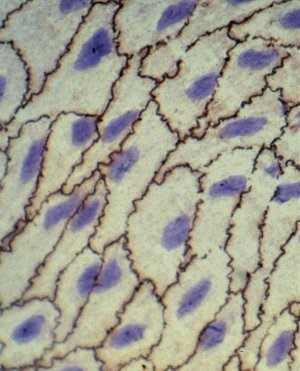
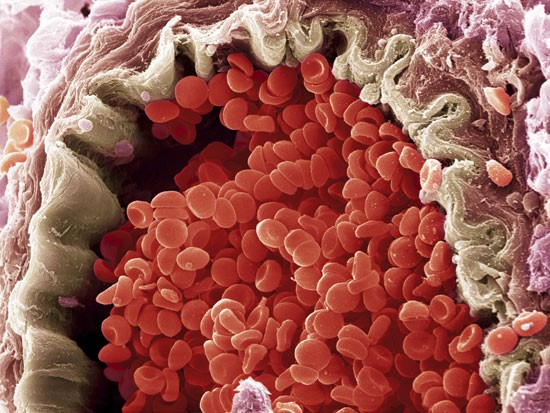
Contrary to popular belief, the veins are not blue. The color of most blood is a transparent yellow which is due to the majority of blood being composed of blood plasma (If you have seen blood centrifuged, you know what I am referring to). The hematocrit is the only part of blood that is red: dark red if deoxygenated and bright red if oxygenated. No blood is blue (inside the body or out). Dried blood which has no gaseous oxygen in it is still red (though a brownish red at that) because the iron in the blood is still rusted from oxidation. The red blood cells have iron in them due to the hemoglobin molecule in them. It is the iron in blood which attracts oxygen that gives it its red color. The reason why only veins appear blue is because they are the most superficial to the skin and therefore seen by the eye. Arteries can not be seen because of how deep they are in the body (a protective mechanism of our bodies). The color blue/violet is the highest frequency of the visible light scale; it therefore has the most penetrating power to be seen through skin, fat, etc. Red is low-frequency and is filtered out by skin and fat, which is why it cannot be seen. If you took a red diode light and put it in milk, it would appear blue in color because milk filters the red out much like our fat/skin. Try it and see!
-
MacArthur Grant Application
INTENDED USE For the research, development, and construction of a simulator that can be used relatively inexpensively to motivate and educate the general public about the future of aviation and space travel. PARTICIPANTS Jason Reskin – Graduated, with honors,CentralMissouriStateUniversitywith a Bachelor of Science in Flight Operations. He has been involved with eight (8) similar projects since 1984. His experience includes flight operations, networking (IPX and TCP/IP), programming (C++, DirectX API, and web design), engineering and pneumatics, astrodynamics, and computer hardware installation. He is currently an airline pilot for a Delta subsidiary. He will be the project manager and will oversee the programming and construction. Ian Lambert- GraduatedKansasStateUniversitywith a Bachelor of Science in Architecture. He has been involved with eight (8) similar projects since 1988. His experience is with visual expression and is manifested physically (sculptures, murals, paintings, books, blueprints, and storyboards) and virtually (computer graphic meshes and texturization). His creative writing and illustration skills were used to recently publish a book and he is actively working on another. He will be responsible for the artwork used (in the virtual universe and within the simulation) and for architectural blueprints (and conceptual drawings) for construction.
Jennifer Riley – GraduatedSouthwestMissouriStateUniversitywith a Bachelor of Science in Geography. Her studies were concentrated on Travel and Tourism. She has many years of experience in sales and customer service and has excellent organizational skills and leadership qualities. She will be responsible for seeking out and working with interested parties, scheduling the travel and utilization of the simulator itself, and for promotional merchandise,
Bryan Ball – Graduated theUniversityofNotreDame with a Bachelor of Science in Computer Science. He has experience with C++, Visual Basic, Perl, PHP, ASP, SQL, JavaScript, HTML, database design, and application architecture. He is currently working on a Microsoft implementation of a web-based Customer Relationship Management System for HotJobs.com. He will be the webmaster for the informational site and will oversee the compatibility with the open standards that are currently being developed.
Wade Tripp – Graduated theUniversityofKansas Citywith a Bachelor of Science in Computer Science. He has experience with GUI design, software development, and has been a valuable consultant for eight (8) previous projects since 1984. He currently administrates theParkUniversitynetwork and webpage. He will be responsible for programming design, databases, API and platform selection, and web interface integration.
Kari Perry – GraduatedWilliamJewellCollegewith a Bachelor of Art in Art. She has worked in the graphics field for nine (9) years. Starting out as a layout artist for a newspaper inTexas, she moved to be a designer at an insurance firm inKansas Cityand was responsible for newsletters that went out monthly and biannually to agents. She is currently the creative director atWilliamJewellCollege. Along with all of the other marketing materials used by the school, she creates newsletters to market various departments on campus to the community. She will be responsible for our public relations, marketing, and the weekly publication of a HTML newsletter.
ORGANIZATION STRUCTURE Unistellar Industries (UI) is a registered entity in the State ofMissouri. No parent organization. Argus Foundation is the original and former name which is still registered in the State ofMissouri.
ORGANIZATIONCONTACT INFORMATION UNISTELLAR INDUSTRIES 14500 NW 73RD ST KANSAS CITYMO 64152-5107 Phone:Fax: Web:
E-mail:
(816) 217-****(816) 741-5315 PRINCIPAL CONTACT Jason Reskin is listed as the sole-proprietor and has the title of Project Manager.If the organization is ultimately incorporated (under discussion), then Jason Reskin will become the President. PRINCIPAL CONTACT INFORMATION JASON RESKIN 500 W AIRPORT BLVD APT 1114 SANFORDFL 32773-4978 Phone: (407) 688-7150
