Category: Dropship
-
Wind Tunnel
Sorry I haven’t been posting lately, I have had my head down working on the flight dynamics for a week.
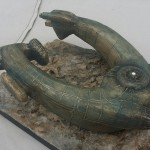
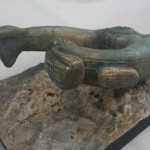
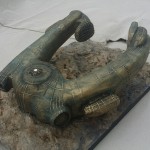
At first I thought the tail design for the Dropship was a V-tail and an inverted Pelikan.
![149px-Tail_pelikan.svg[1]](https://unistellar.risetvp.com/wp-content/uploads/2015/01/149px-Tail_pelikan.svg1_.png)
That would have worked with the existing wind tunnel algorithms from Rise but unfortunately what we are looking at is more like the X-tail concept which is a whole bag of worms with 4 discreet channels that can result in pitch, roll, yaw, and spoiler motions.
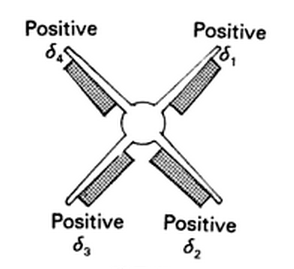
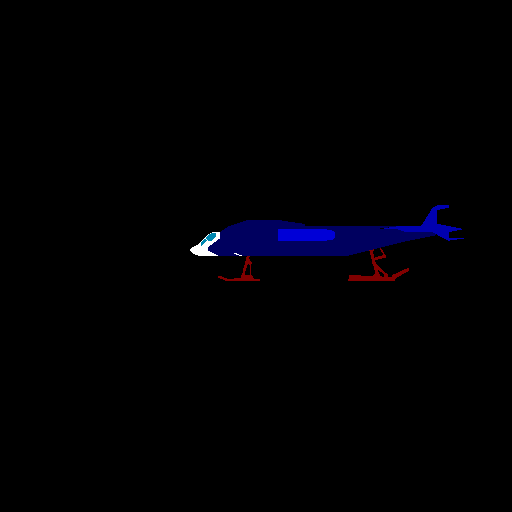
So I am rewriting the wind tunnel piece by piece, taking it to the next level in every respect. For example we used to only count the vertical stabilizer and rudder sections in the weather-vane algorithm. Now I have it computing the clean (gear up) and dirty (gear extended) profile drag and weighted arms for both Z (for yaw) and Y (for roll) tendency!
-
Pressure Sensor
Pretty slick! I originally had a pressure switch that would be open below 60 PSI and closed above 60 PSI for monitoring the pneumatic system using a digital input. That is for our fault tree compliance with ASTM guidelines (shut the motion down if we are below that threshold).
At some point I installed a backup electric compressor which is controlled by the computer. If the pressure was below 60 PSI the compressor would turn on – but when do we shut it off? It is a dumb pump with no switch of its own. The computer was instructed to only allow duty cycles of 10 minutes so it would basically run for 10 minutes then shut off and be above 60 PSI.
A solution was a different pressure switch – one that opened on pressure fall below 50 PSI but didn’t close the switch until it got to 90 PSI. Seemed like the perfect solution! However, for ASTM compliance we may comply with 60 PSI but not know until we got to 90 PSI. There had to be a better way!
![$_12[1]](https://unistellar.risetvp.com/wp-content/uploads/2015/01/121.jpg)
This guy has a 0.5 V to 4.5 V linear signal voltage representing 0 PSI to 200 PSI respectively. Instead of using a digital input, I put it on one of my available analog inputs and viola! I have a pretty accurate measurement throughout the range of pressures at any time for about $25!
-
Bass Shakers
I have used these before and they would be great for effects like collisions but get tiring and are too arcade-like for continuous effects like the engines.
![$_57[1]](https://unistellar.risetvp.com/wp-content/uploads/2015/01/571-1024x1024.jpg)
When I flew in the level D simulators at Delta I remember feeling the seams in the concrete and the runway grooves but neither of those apply to a vehicle without wheels.
So although I have an unused LFE channel I don’t think it is currently with the investment to use it yet.
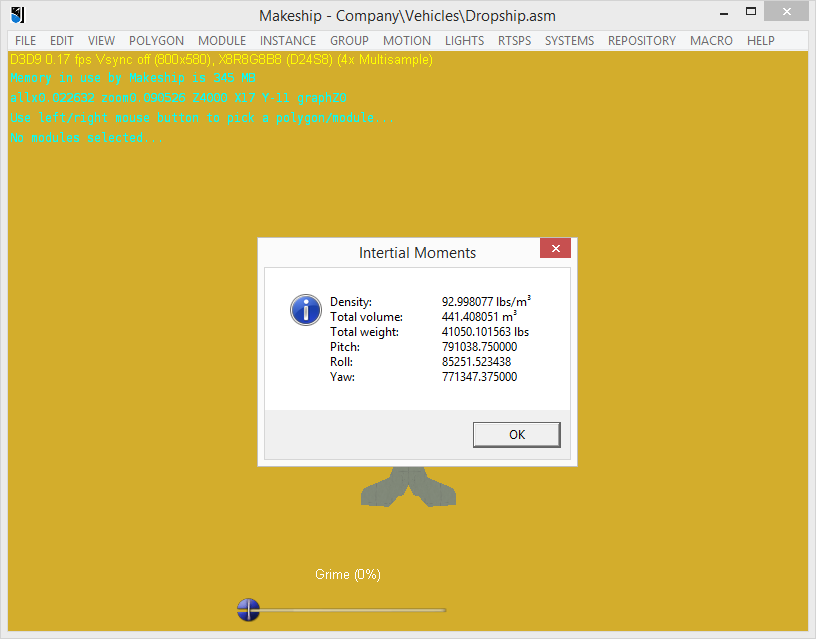
Verified the functionality of the Moment of Inertia calculator in Makeship last night! Turns out I forgot a lot about inertial physics formulas over the last 10 years but I am all brushed up again!
That being said, I already found an issue in the wind tunnel routine – the torque moment which later gets applied to the inertia is not taking into account out-of-plane degradation (force is not applied exactly perpendicular to the axis).
A big caveat for both of these routines is that the origin for the individual modules is at 0, 0, 0 representing the CG.
-
Airfoil Modelling
Testing the flight physics one thing that struck me was that beyond the critical AOA for a given airfoil we were simply setting the coefficient of lift to 0. I think the reason is that most of the charts only continue plotting maybe 5 degrees beyond the critical AOA. However, I found a source for a symmetrical airfoil (no camber) which was taken all the way through 180 degrees of AOA!
![cl-vs-alpha-180deg[1]](https://unistellar.risetvp.com/wp-content/uploads/2014/12/cl-vs-alpha-180deg1.jpg)
The lift coefficient pretty closely follows a f(x) of sin(x/90*pi-0.04)+0.04 except for in those laminar flow regions from alpha 0 to 25 and 155 to 180. Although the drag is absurd at 45 degrees AOA, the lift produced is almost equal to that at the critical AOA of 15!